Brief given on 27/01/22, finished on 01/03/22. This project is centered around the RSA design awards, where there is a number of briefs to be chosen, all related to changing the world in some sort of ways through problem solving in different ways. There are a number of briefs,each tackling a different issue, and one has to be chosen. The options are shown below. We were debating wether to choose Moving Pictures or Collective Imagination, the first choice would have been Moving Pictures, since Liza and I both have backgrounds in animation and visual languages. But we set ourselves a challenge and decided to go with Collective Imagination.
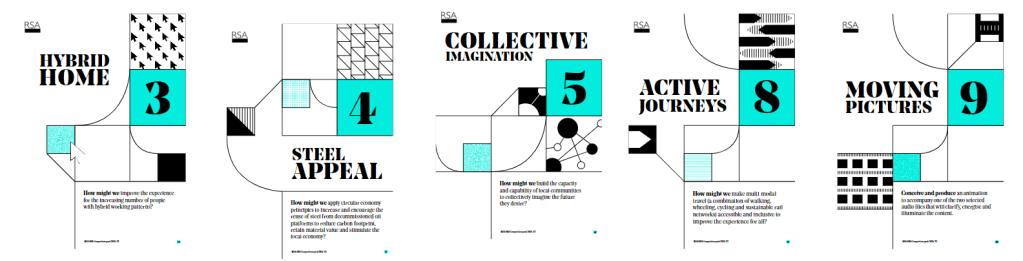
This brief is centered around finding a community that undergoes a specific issue, and finding a way to sove it that directly involves that community and their ideas. The solution must be able to be replicated. Our first thought was to find a community that we both new that was undergoing a societal issue,but all we could think of were communities local to our home countries (Spain and Kazakhstan), and since we are not accquainted fully with the UK we though that our solution could be slightly out of touch. We were very daunted by the pitch, that asked for a very grand idea that could change the realities of many people. This was a very hard brief.
We study at Kingston University, specifically KSA (Kingston School of Art). The campus has a river beside it, the Hogsmill, and the surrounding streets are extremely peculiar. The houses are almost cottages, each one with specific features that give them personality. It’s an extremely beautiful area filled with artists,creativity and beautiful vegetation. A couple of months ago, Liza and I had the idea of making a project that involved those streets, documenting the lives of its inhabitants and their peculiarities. We were very passionate anout this idea, that sat on the back of our minds for some time.
So we decided to incorporate that into this project. What better way of engaging with a community if you’re part of it? We had a talk with one of our coursemates and friends, Helena, that was telling us that the mental health programme in our university was basically garbage. There are many people in our university that deal with mental health and therapy is expensive and inaccessible. Universities usually have schemes in place to help the students, supplementing a private therapist and providing that service to whoever needs it. Sadly, our university centers its scheme around academic performance, which can’t happen properly if someone is undergoing serious mental health issues (specially taking into accound the stress that university brings. On top of that, we are talking about art students, where the university demands constant creativity and innovation, along with quality work. If the student is undergoing serious mental stress, being creative is out of the question.
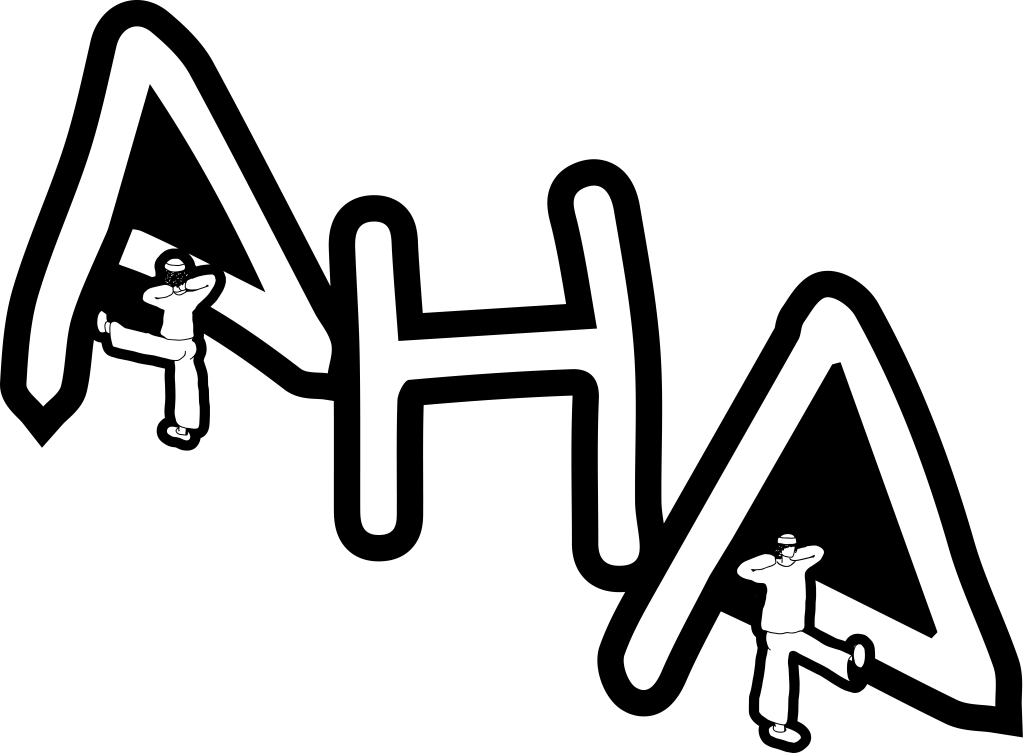
From there we decided on the name, ‘AHA’ (Art to Help Art). We were thinking of ways in which we could create a space of mind in the student where they can create and express themselves with a bit less mental struggle. At first we were thinking of a physical space that encourages stress-free expression and a more laid-back view of work. After that we remembered the streets leading up to uni, how beautiful and relaxing they are. I saw that one of the ways in which I decide to rest and clear my head is by having a walk on that area.
We decided to create a curated walk around that area, a 5-minute stroll where we would point out small landmarks in the area (such as cute signs in the houses, trees that bloom, or art installations put up by the locals). We decided to do this in the form of a small pamphet, an A4 page folded in such a way that it takes you along the pretty little landmarks in the environment next to you, and then encourages you to go on a 5 minute walk to clear your mind. We would place this pamphlet in front of people in the library or the canteen, so that they could take a look around our pretty illustrations (effectively taking their mind off things for a second) and maybe deciding to go on the walk.
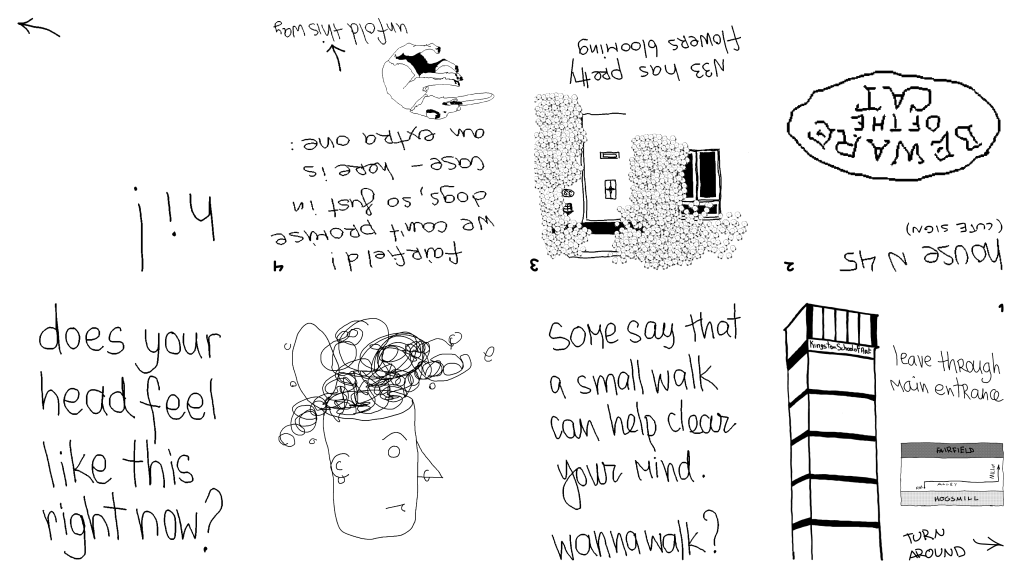
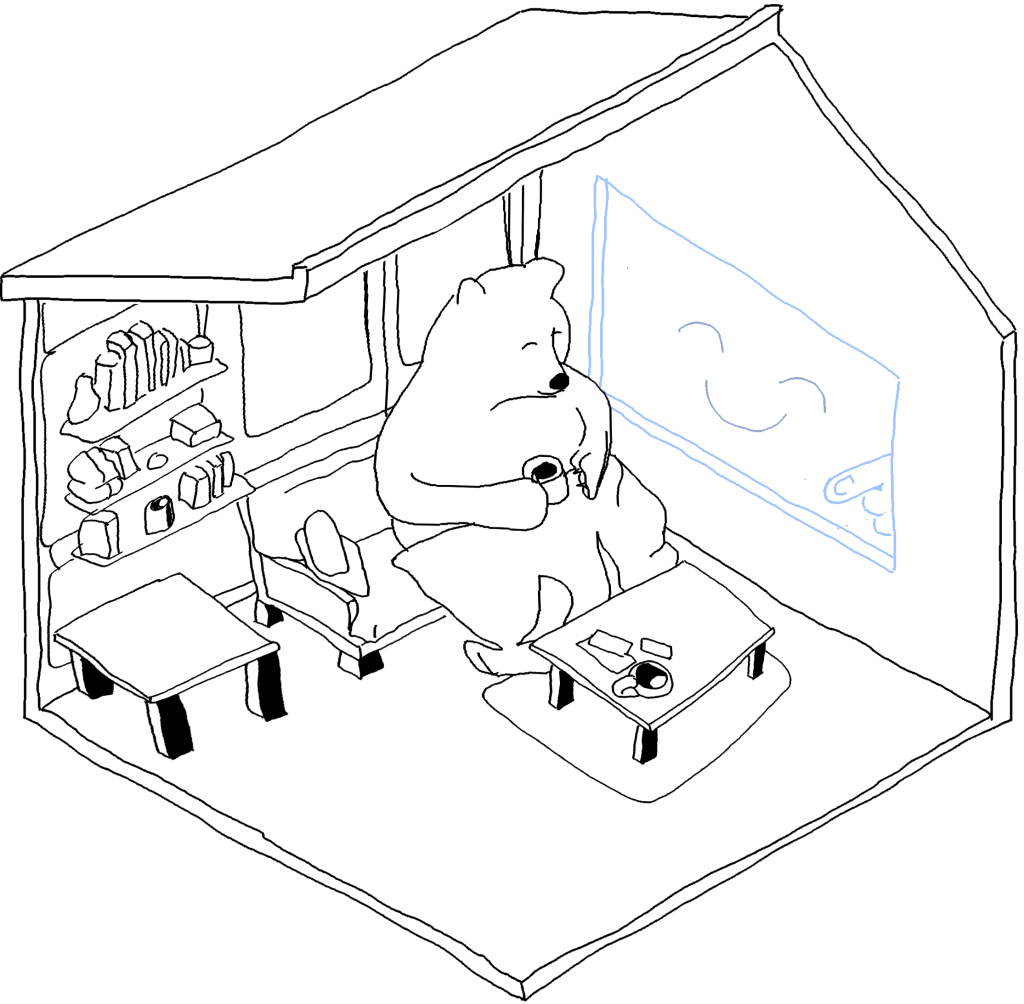
THe fact that the walk is intentioned is very important. It’s very different going on a walk without aim than going on a treasure hunt. It gives that interactive element that makes it all the more effective to stop the student from focusing on what’s going wrong. Our tone is very informal, laid back, not serious whatsoever and a bit ridiculous. We made the illustrations in MS Paint to give a more approachable look, making it as simple as possible.
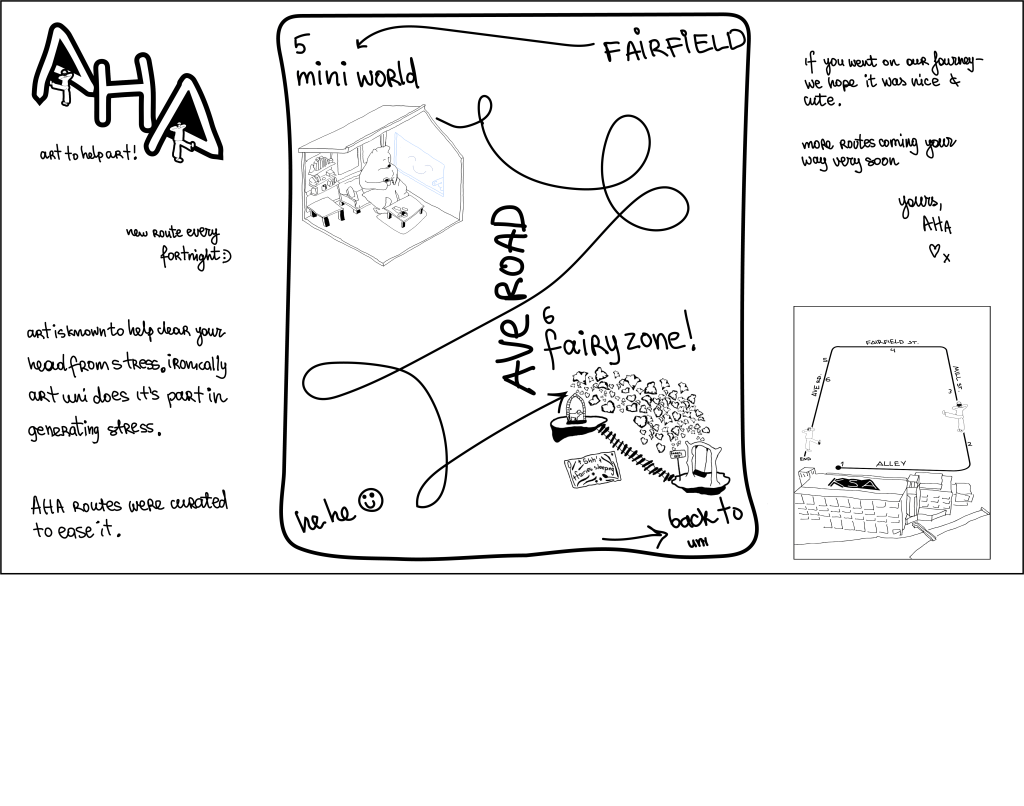
This would be a monthly edition, where we would propose a new route and things to see, taking into account the changing of the seasons. We would also encourage students to submit their works so they can be put up on the route and featured in AHA. We wuld encourage small pieces they may have already done, pretty little things that take no effort to submit and put up. This would directly envolve the community, better the area, and make people proud of what they’ve done when seeing them out in the street.
To the other point of the brief, this is easily replicated. We got all the illustrations together on the pamphlet in two days, this is something that really takes little to no effort. If another university, or institution with workers that might need a break, designs a 5 minute walk around the workplace with things to look for, our idea will be accurately replicated. We considered making a template, but since one of the main points was to give emphasis on creativity, we thought that it would go against what we’re trying to accomplish.
When pitching this to the class, we had overwhelmingly good feedback from the students, saying that it’s something they needed, that was very accurate and effective. This just proves that our community would meaningfully engage and benefit from this. The teachers, although they liked it, considered it maybe a little bit too simple, saying that it looks like a prototype. RSA looks for bigger ideas. Although this criticism is valid, this idea would not benefit from being complicated. If a student saw this big mental health initiative that encouraged them to take a walk over Kingston, they would just pass. The idea was to make this as easy,frictionless, and low effort as possible so that a busy student could engage with it.
Overall, I loved working on this project, we were very passionate about it and the process was delightful. Most importantly, it was effective. We will most propably not win this, since the ideas they look for are bigger,but I truly think that these small things are what make a true difference to the individual. I’m sad I don’t have the time to make one of these every month, maybe in third year I’ll consider carrying this through.
Thank you for reading.
 NAMENOTFOUND//